The timeline
Government announces a package of revised planning exemptions covering extensions, garden dwellings, house subdivision, dormers and rooflights.
S.I. 338 to 344 of 2026 are signed - the first substantial rewrite of the exempted-development Schedule since 2001.
The new limits and classes commence: 45 m² extensions, 30 m² garden rooms, Class 3A garden dwellings, Class 1A subdivision, 1B dormers, 1C rooflights.
The garden-dwelling and subdivision exemptions are time-limited: works must be commenced and completed by the end of 2030.
On the record
The principal instrument of the package: raises the exempt rear-extension limit from 40 m² to 45 m² and the detached garden-room limit from 25 m² to 30 m², with the cumulative counting rule (every extension since 1 October 1964) retained.
Full text, Irish Statute Book (PDF)Creates Class 3A: a detached habitable garden dwelling of 32 to 45 m² in the garden of a house, occupied only in conjunction with the principal house, not to be sold or let separately, subject to a 14-day prior notification (with Eircode) to the planning authority before works commence.
Full text, Irish Statute Book (PDF)What changed on 27 July
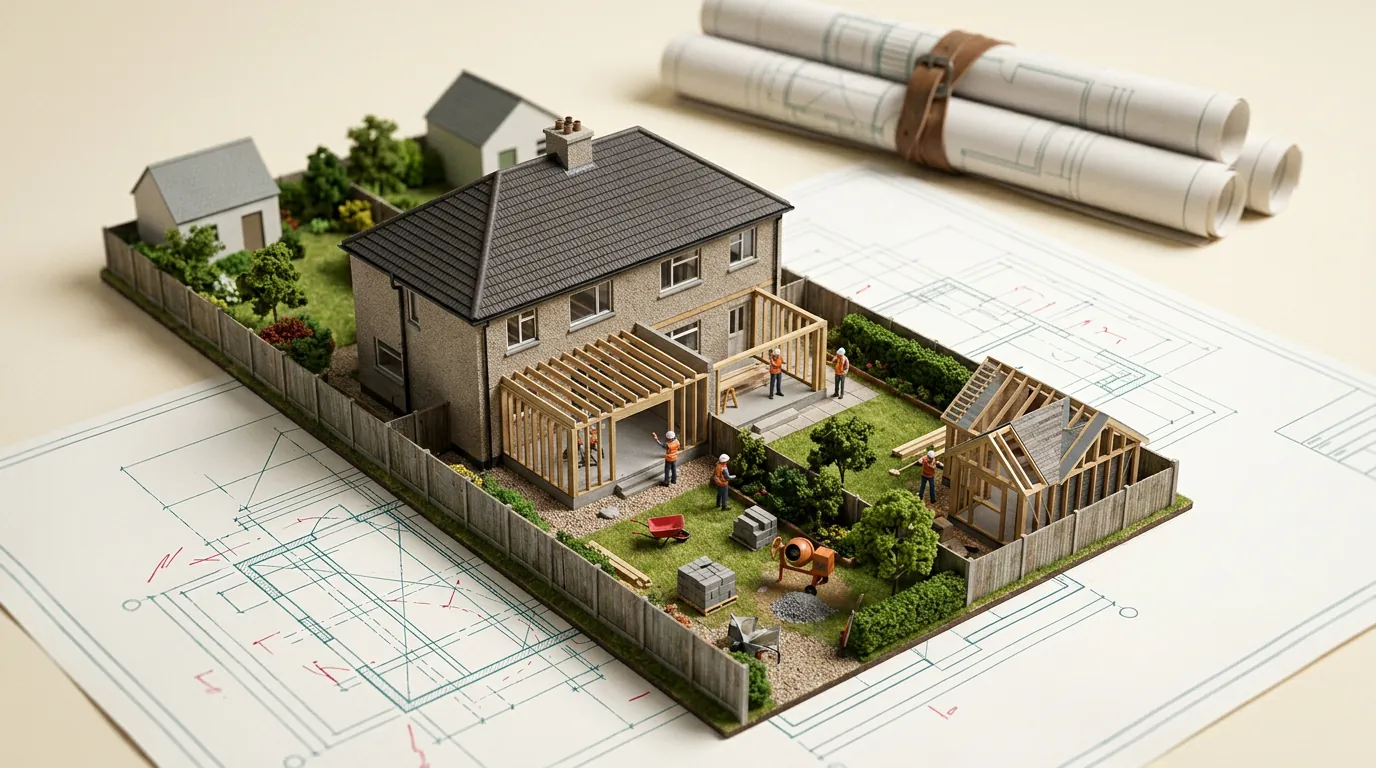
Schedule 2 of the planning regulations - the list of what can be built without permission - had not been substantially rewritten since 2001. On 27 July 2026 it was. The exempt rear-extension limit rose from 40 m² to 45 m², the detached garden-room limit rose from 25 m² to 30 m², and, for the first time in the history of the State's planning code, a detached habitable dwelling in a garden became exempt: Class 3A, at 32 to 45 m². A house can also now be subdivided into two self-contained units, and side and rear dormers and front rooflights gained exemptions of their own.
Two of the new classes carry a procedural novelty: a 14-day prior notification to the planning authority, Eircode included, before works start. It is not an application - nothing is assessed and nothing is granted - but works started without it are not exempt.
The conditions that still bite
None of this is a free-for-all. The extension allowance is cumulative: every extension since 1 October 1964 counts against the 45 m², including ones a previous owner built with permission. The garden dwelling cannot be sold or let separately, short-term letting is barred, the owner must live in the principal house, and a mobile home does not qualify. Protected structures and architectural conservation areas can lose any of these exemptions case by case, and the two new residential classes expire at the end of 2030.
Borderline cases have a formal answer: a Section 5 declaration from the council - EUR 80, answered within 4 weeks - is far cheaper than building wrong.
This time the demand really does go dark
The easy reading of the rewrite is that a slice of Ireland's small-works pipeline just went dark: no application, no register entry, no lead. Unusually, the easy reading is right - and it is darker than it looks, because building control does not catch these projects either. Under the Building Control Regulations, works that are exempt from planning and need no fire safety certificate need no commencement notice, and houses and domestic extensions need no fire safety certificate. So an exempt 45 m² extension or Class 3A garden dwelling files nothing with BCMS. The building regulations still fully apply to the work itself; there is simply no public paperwork announcing it.
The one statutory trace is the 14-day prior notification a garden-dwelling builder must send the council - and the council is only required to keep it as an internal record and report the annual count to the Minister. No register, no weekly list, no publication. For the first time since 1964, a fast-growing class of residential construction is invisible to every public record until the day the builder's van arrives.
Check before you build
The conditions above are exactly the kind that catch people: cumulative allowances, boundary distances, an extension a previous owner built in 1998. The exemption checker walks the new rules as a short decision tree and gives a verdict - exempt, exempt with conditions, or needs permission - citing the class and the S.I. behind it.
The detail lives in the guides: house extension rules, garden room or garden dwelling, and the granny-flat routes.
What to watch next
- Whether councils publish the 14-day prior notifications - if they do, they become a brand-new public record of garden-dwelling starts that nobody aggregates yet.
- The first aggregate uptake numbers: per-council notification counts are obtainable by FOI or AIE request, and the Government's 18-month review of the exemption will surface national figures - the first hard read on how much building the new classes unlock.
- Whether the 31 December 2030 sunset on the garden-dwelling and subdivision classes is extended once the scheme beds in.
Source: PlanningLeads Briefs - "The first rewrite of Ireland's exemption rules in 25 years" (planningleads.ie/briefs/exempted-development-rewrite-2026)
Free to quote with attribution. Underlying statistics derive from public registers (CC-BY sources credited per figure).
Sources
- S.I. No. 338 of 2026 (Irish Statute Book)
- S.I. No. 339 of 2026, Class 1A subdivision (Irish Statute Book)
- S.I. No. 340 of 2026, Class 3A garden dwelling (Irish Statute Book)
- Government announcement of the exemption changes (gov.ie, 21 Apr 2026)
Method: based on the public planning register as ingested by PlanningLeads at the time of writing. Registers update as cases progress - always check the live record before relying on a status. Organisation applicants only; no personal data is reported.